Company Registration in Tanzania (2025) | Start a Business Fast with Glenrich
Looking to register a company in Tanzania? This complete 2025 guide explains costs, requirements, timelines, and compliance tips. Glenrich helps entrepreneurs and foreign investors launch and scale their businesses with ease.
Introduction
Starting a business in Tanzania in 2025 presents incredible opportunities for entrepreneurs, startups, and foreign investors. With one of the fastest-growing economies in East Africa, a strategic location that connects to regional and global markets, and government-driven reforms to improve the ease of doing business, Tanzania has become an attractive hub for investments across industries such as tourism, construction, manufacturing, fintech, and agribusiness. However, success begins with understanding the company registration process and ensuring your business is fully compliant with local laws.
Registering a company in Tanzania is governed by the Companies Act, Cap. 212, which outlines the procedures for establishing different types of entities, including Private Limited Companies (LLCs/LTDs), Public Limited Companies (PLCs), branches of foreign companies, and non-profit organizations. Whether you are a local entrepreneur launching a startup or a foreign investor expanding into East Africa, navigating the process correctly can save you time, money, and unnecessary legal complications.
In this comprehensive business registration guide, we break down everything you need to know — from choosing the right business structure to obtaining work permits, tax identification numbers (TINs), licenses, and bank accounts. We’ll also cover the costs, timelines, and compliance requirements based on the latest updates from BRELA, the Tanzania Revenue Authority (TRA), and immigration regulations. For foreign investors, we provide practical insights into setting up subsidiaries, branches, and investment structures tailored to Tanzanian law.
Unlike many generic articles online, this guide focuses on actionable steps and strategic insights. It doesn’t just tell you how to register a company in Tanzania — it explains the why behind each step and highlights common mistakes to avoid, such as choosing the wrong company type, failing to meet capital requirements, or overlooking sector-specific licenses. Whether your goal is to launch a small business, scale a tech startup, or establish a multinational subsidiary, this resource is designed to make the process simple, clear, and efficient.
At Glenrich, we specialize in helping entrepreneurs and investors register, structure, and scale their businesses in Tanzania with full regulatory compliance. From handling BRELA filings to securing permits, tax registrations, and financial management systems, our team ensures that you can focus on growing your business while we handle the complexity behind the scenes.
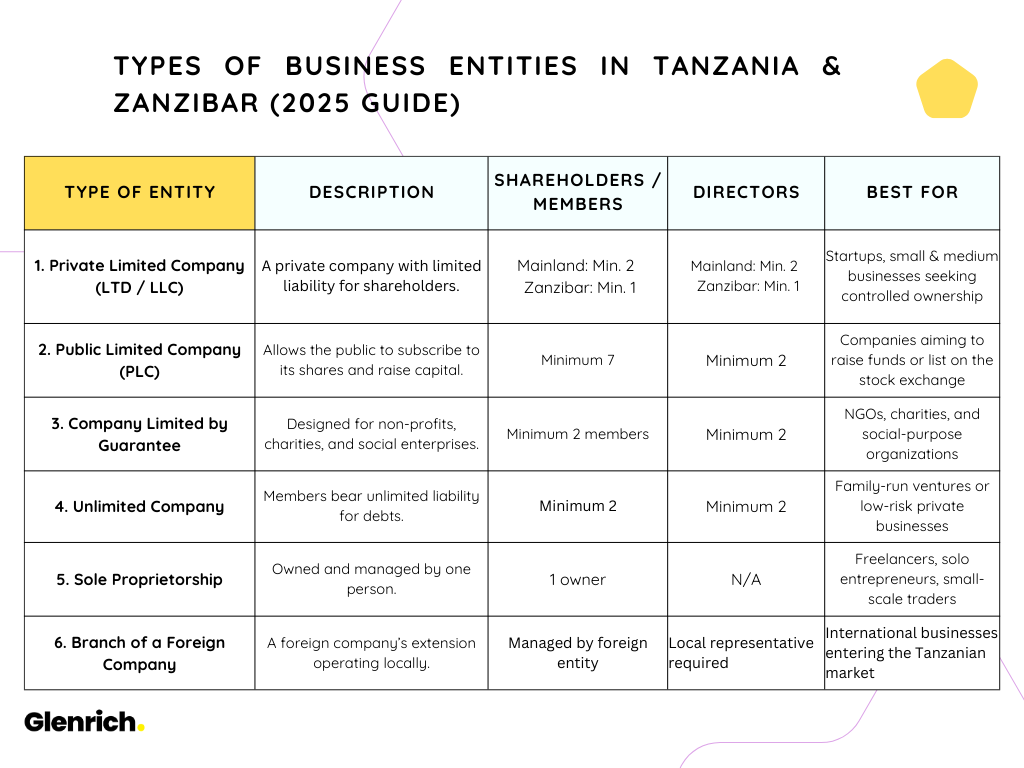
Types of Companies in Tanzania
Choosing the right company type is one of the most critical decisions when starting a business in Tanzania. Each legal structure has its own requirements, liability implications, and suitability depending on your business goals, industry, and investor profile. Tanzania recognizes several types of companies under its laws, primarily governed by the Companies Act, Cap. 212.
Step-by-Step Company Registration Process in Tanzania
Registering a company in Tanzania involves several key steps. Following this process carefully ensures legal compliance, avoids delays, and sets a strong foundation for your business operations.
Step 1: Reserve a Unique Company Name
Before registering, your company must have a unique name that aligns with Tanzanian regulations.
Action Points:
- Conduct a name search using BRELA’s online system.
- Reserve at least 3 unique names for approval.
- Ensure the name does not infringe trademarks or existing businesses.
Cost: TZS 50,000
Timeline: 1–2 working days
Step 2: Prepare the Memorandum & Articles of Association
These documents define your company’s purpose, structure, and governance.
Action Points:
- Draft the Memorandum outlining company objectives.
- Draft Articles of Association detailing director responsibilities and shareholder rights.
- Complete Form 14B (Declaration of Compliance).
- All directors/shareholders must sign the documents; those outside Tanzania must use apostille or Tanzanian Embassy authentication.
Tip: Engage a legal professional to ensure compliance.???
Step 3: Identify Business Activities & Required Capital
Your business activities determine the licenses, permits, and minimum capital requirements.
Action Points:
- Define your primary business activities using ISIC codes.
- Check industry-specific capital requirements: e.g., microfinance businesses require TZS 20,000,000.
- Prepare proof of initial capital deposit if required by law.
Step 4: Nominate Directors & Shareholders
Choose who will manage and own your company.
Requirements:
- LLC/LTD in Mainland Tanzania: Minimum 2 directors & 2 shareholders
- Zanzibar: Can have a single director and shareholder
- Foreign shareholders must submit passport copies and other statutory documents.
Tip: Clearly define shareholding ratios and roles in the Memorandum & Articles.
Step 5: Secure the Required Capital
Deposit the minimum required capital based on your business type or sector.
Action Points:
- Deposit funds into a local bank account (some sectors require 25% upfront).
- Obtain a bank statement as proof.
Step 6: Obtain Tax Identification Number (TIN)
Every director and shareholder must have a TIN from the Tanzania Revenue Authority (TRA).
Purpose:
- Required for tax compliance, opening bank accounts, and company registration.
Step 7: Submit Registration Documents Online
Use BRELA’s Online Registration System (Mainland) or Zanzibar Property and Business Registration System.
Required Documents:
For Local Companies:
- Name Reservation Confirmation
- Memorandum & Articles of Association
- Shareholders & Directors details (IDs, photos, TINs)
- Declaration of Compliance (Form 14B)
- Form 434 (office address, director list, local representatives)
- Integrity Pledge Form
For Foreign Companies / Branches:
- Certified copies of parent company documents
- Board Resolution authorizing the branch
- Local Representative appointment
- Statement of Charges on assets
- Audited Financial Statements
- Work & Residence Permits for foreign employees
Timeline: 3–14 working days depending on document readiness
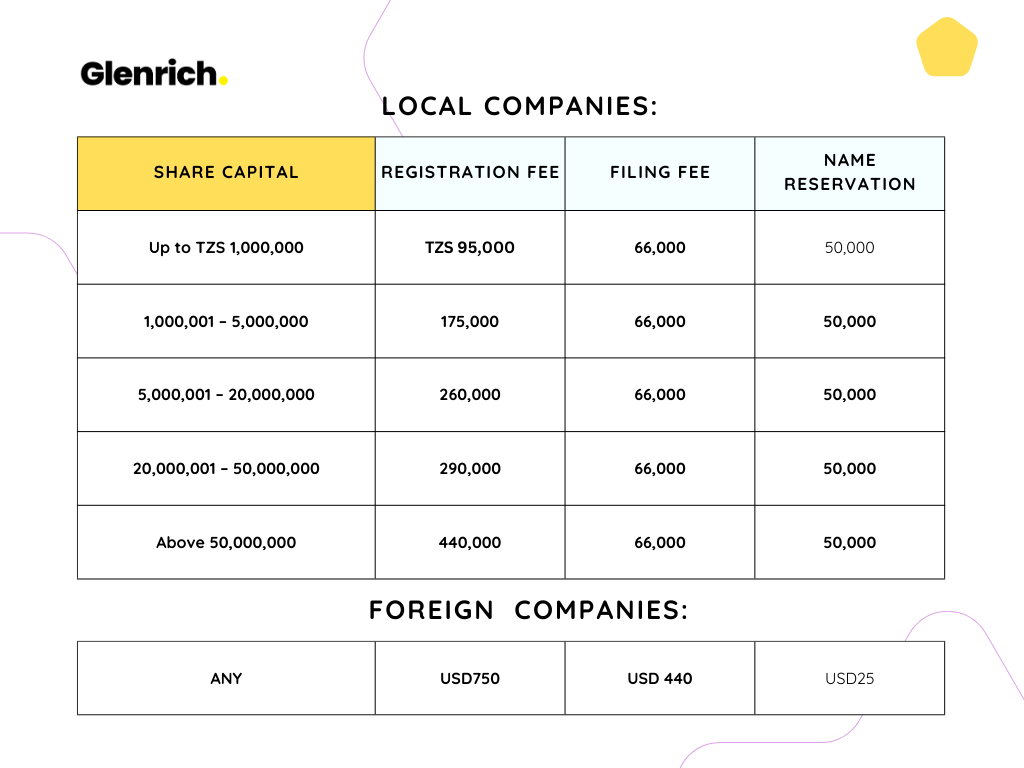
Step 8: Pay Registration Fees
Step 9: Obtain Certificate of Incorporation
Once BRELA approves your application, you receive the Certificate of Incorporation.
Includes:
- Company registration number
- Official incorporation date
- Legal confirmation of company existence
Timeline: 3–14 business days
Step 10: Register for Tax & Social Security
After incorporation:
- Register with TRA for VAT (if turnover exceeds TZS 100 million)
- Register with NSSF for employee benefits
Step 11: Obtain Business Licenses
Depending on your sector:
- Apply for general or sector-specific licenses
- Ensure OSHA compliance for regulated sectors
Step 12: Open a Local Bank Account
- Required to deposit initial capital and conduct business transactions
- Popular banks: CRDB, NMB, Stanbic Bank Tanzania
Step 13: Immigration Compliance for Foreign Directors/Employees
- Apply for Class A (Investors) or Class B (Skilled Workers) work permits
- Obtain residence permit for long-term stays
- Short-term business visits can use a business visa
Conclusion: What Comes After Registration
Completing the company registration process in Tanzania is a major milestone, but it’s only the beginning of your business journey. Once you receive your Certificate of Incorporation, your company becomes a recognized legal entity — ready to operate, open bank accounts, hire employees, and engage in business activities.
However, registration alone does not make you fully compliant. Every company — whether locally owned or a foreign branch — must fulfill a series of Post-Registration Compliance obligations to avoid penalties, financial risks, and possible deregistration.
For Foreigners Establishing Businesses in Tanzania
If you’re a foreign investor or setting up a branch of a foreign company, it’s important to understand that registration grants you the right to operate but also brings specific liabilities and responsibilities. Among these are obtaining the appropriate work permits, complying with tax requirements, filing annual returns, and meeting all statutory reporting obligations.
Failing to adhere to these compliance rules can lead to:
- Financial penalties
- Suspension or cancellation of licenses
- Restrictions on profit repatriation
- Possible blacklisting of directors or shareholders
To ensure smooth operations and protect your investment, businesses — especially foreign-owned entities — must prepare for the Post-Registration Compliance phase immediately after completing the registration process.
Why Post-Registration Compliance Matters
Managing your post-registration obligations ensures that your business remains in good legal standing with Tanzanian authorities, avoids costly mistakes, and builds a strong foundation for sustainable growth. This includes:
- Applying for a TIN and registering for taxes
- Obtaining business licenses and permits
- Complying with labor and immigration laws
- Preparing for annual returns and statutory audits
At Glenrich, we help businesses navigate every stage of the process — from registration to Post-Registration Compliance — ensuring you stay compliant, efficient, and ready to scale confidently.